Outside a bar magnet, do the field lines run from north to south, or from south to north?
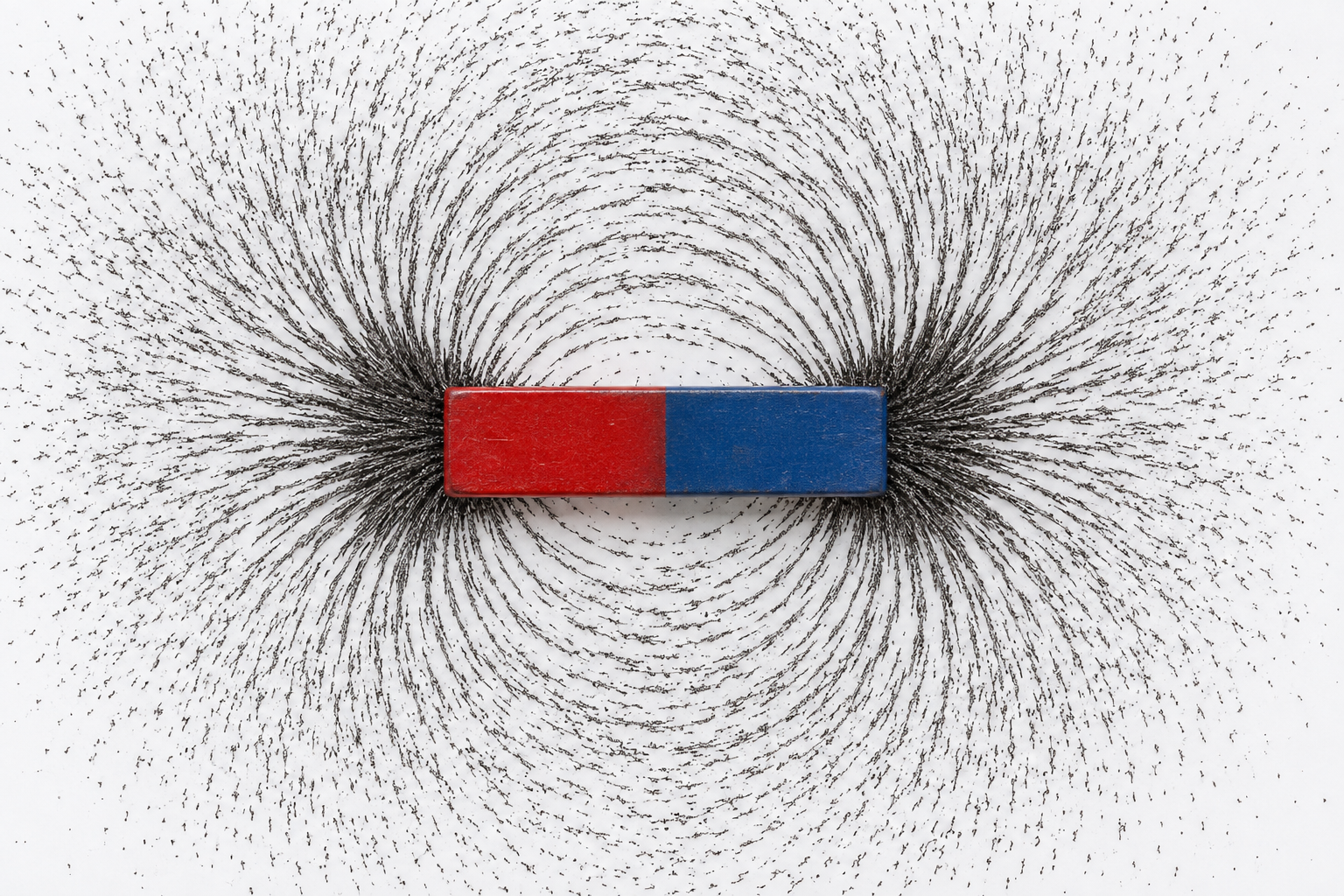
One source is left to draw: the bar magnet. Its field is the classic pattern, the one iron filings reveal when they are sprinkled around a magnet. Each filing sits like a tiny probe, lining up with the field at its own spot.
Here is the finished sketch of a bar magnet's field.
A correct bar-magnet sketch has three features, checked in order.
Feature 1 is direction: outside the magnet, every field line leaves the north pole and enters the south pole.
Outside a bar magnet, at which pole do the field lines start?
Feature 2 is shape: the lines curve around from pole to pole. No line stops in mid-air, and no two lines cross.
Feature 3 is spacing, and it rests on the rule you have: where field lines are closer together, the field is stronger. A magnet's field is strongest at its poles, so the lines sit closest together at the two poles.
In a correct sketch, where do a bar magnet's field lines sit closest together?
Check a sketch of a toy magnet's field: lines leave the north pole, enter the south pole, curve around without crossing, and bunch at the poles. Does the sketch pass all three checks?
Direction: the lines leave the north pole and enter the south pole. That check passes.
Shape: the lines curve pole to pole and never cross. That check passes.
Spacing: the lines bunch at the poles, where the field is strongest. That check passes.
The sketch passes all three checks.
A correct sketch of a bar magnet's field has which set of features?
Polly and Casper each sketch a compass needle's field. Polly's lines leave the north pole; Casper's lines leave the south pole. Outside the needle, whose direction is correct?
In a correct sketch, a bar magnet's field lines bunch at the poles. What does the bunching say about the field?
The table lists the features of Idris's sketch of a door magnet's field. Which change makes the sketch correct?